
by VAN HANSEN
Update, October 28: The Bank of Canada raised its policy rate a quarter point to 2.50% this morning, its first increase since July 2023. The forecast held. Governing Council said it acted to reduce the risk that high energy prices spread to other goods and services, and that there “could be a need to increase the policy rate further,” but it will “proceed carefully.” The Bank now expects inflation to rise to about 3½% by year-end and average 3% in 2027. Next decision: December 9.
Sailors know the marine forecast is a best guess, not a promise. The only certainty is that conditions will change. Economists are in the same boat so to speak.
Ten days ago, few expected the Bank of Canada to raise rates on Wednesday, October 28. But today markets put the odds at better than four in five.
The Bank has held steady on its overnight rate at 2.25% seven times in a row. The fact that as recently as September, most economists expected it to stay put through the end of the year was no surprise.
Then, on a Saturday in mid-October, the wind shifted.
A forecast overtaken by events
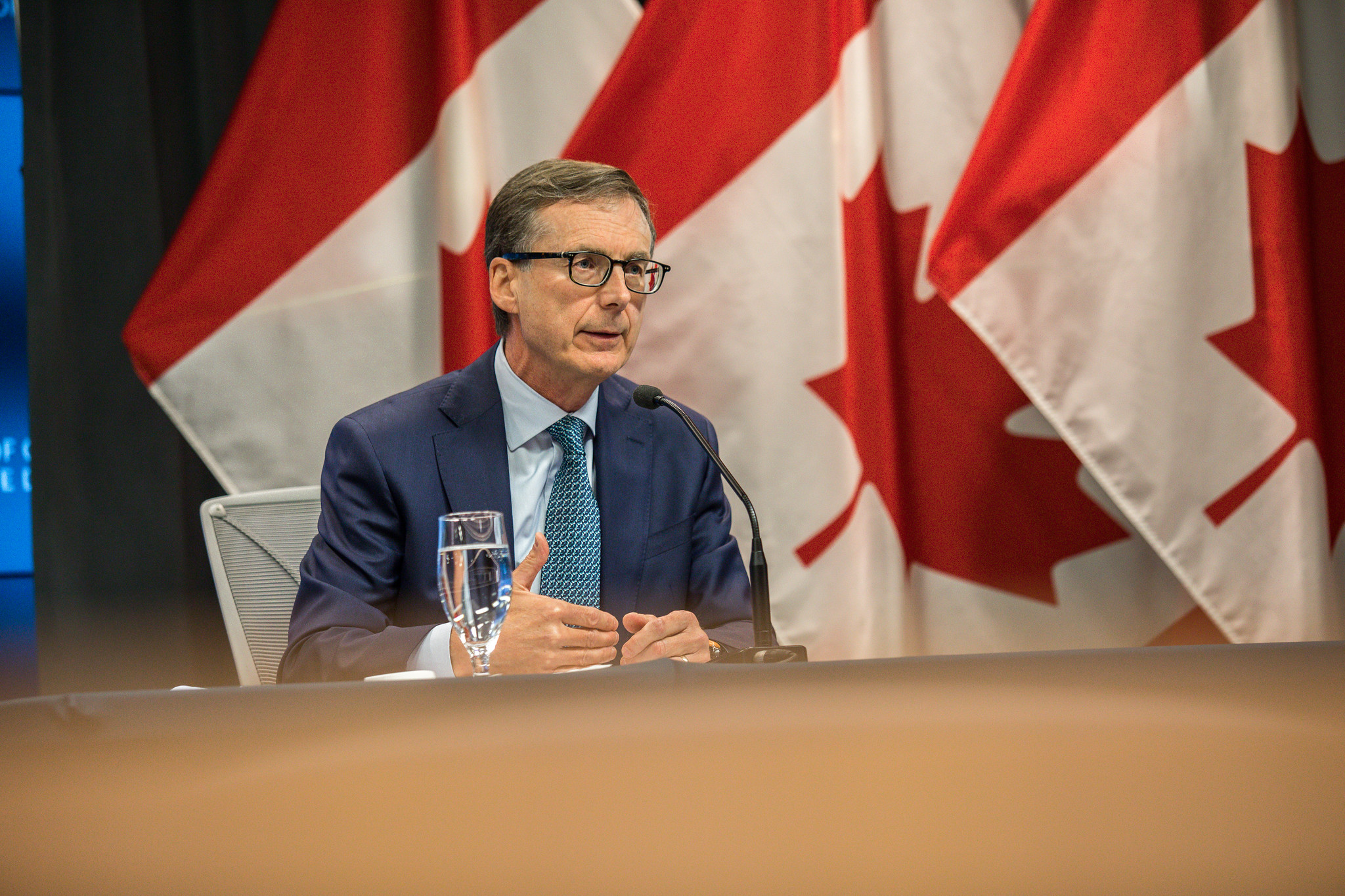
On October 17, Governor Tiff Macklem spoke to reporters on a conference call from the IMF and World Bank meetings in Bangkok. He didn't announce a rate change. He didn't need to.
The Bank's July forecast, he said, had been overtaken by events. It had expected inflation to go down to about 2.5% in the second half of the year. Instead, headline inflation held at 3% through August, with oil prices above $100 (US) a barrel. The Bank's new inflation forecast, due with Wednesday's decision, would be significantly higher.
And then the words that moved markets. Macklem said "the risk that inflation broadens and becomes more persistent has gone up."
He also framed Wednesday's choice plainly: will inflation drift back toward target on its own, or does the Bank need to raise rates to steer it there?
What the markets heard
Two days later, Statistics Canada reported September inflation at 3.1%, a touch below the 3.2% economists expected. The Bank's preferred core measures, which strip out volatile items like gas, averaged 1.9%, under the 2% target. Canada had also lost 68,000 jobs in September, its second weak month in a row.
On that data alone, the argument for a hike didn’t hold water.
Markets weren't trading on that data. The same day, the Bank's own surveys showed businesses and consumers expecting higher inflation ahead, with many firms planning to pass rising costs on to customers. The Globe and Mail reported that the repricing was driven mostly by the Governor's comments in Bangkok. CIBC's chief economist went further, writing that his bank's revised call rested solely on Macklem's remarks, not the data.
Before Macklem spoke, traders put the odds of an October hike at roughly 30%. By Monday, October 26, they sat somewhere between 80% and 90%, depending on the source.
Steering, or being steered?
A central banker's words are a policy tool. Every Governor knows it. Talk firmly about inflation and bond yields tend to rise, borrowing gets more expensive, and some of the Bank's work gets done before it touches its rate. Just as importantly, this tells households and businesses the Bank won't let inflation run, keeping their expectations anchored, which is half the battle.
But words cut both ways. Since markets have now priced a hike as close to certain, holding on Wednesday would itself be a surprise. Central banks don't like surprising markets. Bloomberg reported that some economists now believe Macklem may have boxed himself into a hike.
So was Mr. Macklem setting a course, or did the market run ahead of him? Only the Bank's Governing Council knows, and it sets rates by consensus, not on the Governor's word alone. What we do know is that his remarks rested on things the Bank can see: oil well above its July assumption, headline inflation stuck above target, and its own surveys showing expectations creeping up.
Not everyone thinks he should follow through, including some who now expect him to. CIBC's Avery Shenfeld moved his own call to an October hike, but warned in his weekly report that moving early "could be a step that the Bank comes to regret." BMO's Douglas Porter wrote that his team changed its call to a hike "with great reluctance," blaming what he called the Governor's fixation on headline inflation. And the C.D. Howe Institute's Monetary Policy Council, a panel of economists that acts as a shadow governing council, said it saw little evidence of broader price pressures, The Globe and Mail reported.
Where the forecasters stand now
Most economic forecasters now agree rates are heading higher. The disagreement is about timing.
In a Reuters poll taken October 21 to 23, 19 of 34 economists, or 56%, called for a quarter-point hike to 2.50%. The previous poll had 80% calling for a hold through year-end. Sixteen of 29 also expect a second hike by the end of March, which would take the rate to 2.75%.
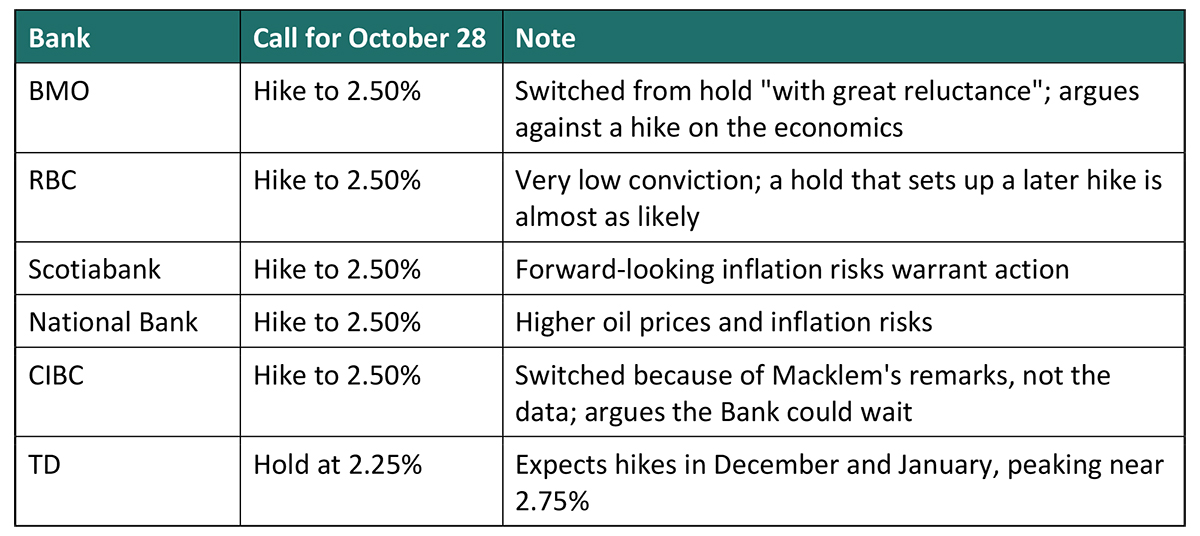
Compiled from Canada’s six largest bank reports and previews as published Oct. 19–26 (Bloomberg, Canadian Mortgage Trends, FXStreet). These are each bank's own calls, separate from the Reuters poll.
Several of the hike calls come with reservations attached. CIBC changed its call only because of what the Governor said, and still argues the Bank could wait. And the holdouts aren't calling for calm seas: TD expects a hold Wednesday, then hikes at the next two meetings.
Whatever happens Wednesday, what the Bank says about its next moves may matter more than the decision itself.
What it means if you're buying, selling or renewing
Everyone’s situation is different, but a quarter point is not a storm. On a variable-rate mortgage, prime usually moves within days of a Bank of Canada decision, so payments would rise modestly. Fixed rates don't follow the Bank directly. They follow bond yields, and yields have already been climbing, which is why fixed rates have been creeping up even while the Bank stood still.
• Buying: Get your mortgage underwritten before you shop, not after. A pre-approval with a rate hold protects you if rates move while you look. I recommend mortgage professionals who do this early, because it's the difference between a plan and a hope.
• Renewing in the next few months: Talk to your mortgage broker now. You have more options before renewal than on the day it arrives.
• Selling: A hike can make some buyers pause, and it can push others to act before rates rise further. I advise clients on the market they’re in, not the one they remember.
The bottom line
Forecasting rates is a lot like forecasting weather. The models are good, the people running them are smart, and they're still sometimes wrong, because the conditions keep changing. Ten days ago the forecast called for status quo. Today it shows a shift.
The Bank of Canada announces its decision Wednesday, October 28, at 9:45 a.m., along with its new forecasts. A hike is now the most likely outcome, but it isn't a certainty, and the bigger question may be how many follow. I'll post an update once the decision is out.
If you're wondering how this affects your own plans, reach out.
Van Hansen, Real Estate Broker, Right at Home Realty Brokerage. Serving Burlington, Hamilton, Oakville and Milton.
__
This post is for information purposes only reflecting published forecasts as of October 2, 2026, updated October 28 with the Bank of Canada’s decision, and is not financial or mortgage advice.
Photos courtesy Bank of Canada except as marked
References
1. Promit Mukherjee, "Bank of Canada sees sharply higher inflation outlook as oil surges, Macklem says," Reuters, Oct. 17, 2026.
2. The Hub Staff, "Macklem signals higher inflation forecast as oil shock tests Bank of Canada's hold," The Hub, Oct. 19, 2026.
3. Statistics Canada, Consumer Price Index, September 2026, released Oct. 19, 2026.
4. Statistics Canada, Labour Force Survey, September 2026, released Oct. 9, 2026.
5. "Financial markets betting on BoC rate hike next week despite subdued inflation data," The Globe and Mail, Oct. 19, 2026.
6. "Macklem Ensnared by Market Pricing and Will Hike, Economists Say," Bloomberg, Oct. 23, 2026.
7. Avery Shenfeld, "We beg to differ," The Week Ahead, Oct. 26–30, 2026, CIBC Capital Markets.
8. Douglas Porter, "The Case Against (Rate) Hiking," Policy Magazine (BMO Talking Points), October 2026.
9. Tim Shufelt, "Is the Bank of Canada about to make a big mistake?" The Globe and Mail, October 2026.
10. Nushaiba Iqbal, "Bank of Canada to raise rates to 2.50% on October 28 and once again by end-March: Reuters poll," Reuters, Oct. 23, 2026.
11. CMT Team, "Economists brace for Bank of Canada hike, but some urge patience," Canadian Mortgage Trends, Oct. 26, 2026.
12. "Traders, Economists Boost Bets on Canada Rate Hike Next Week," Bloomberg, Oct. 19, 2026.
13. Bank of Canada, “Bank of Canada raises the policy rate by 25 basis points to 2½%,” press release, Oct. 28, 2026.